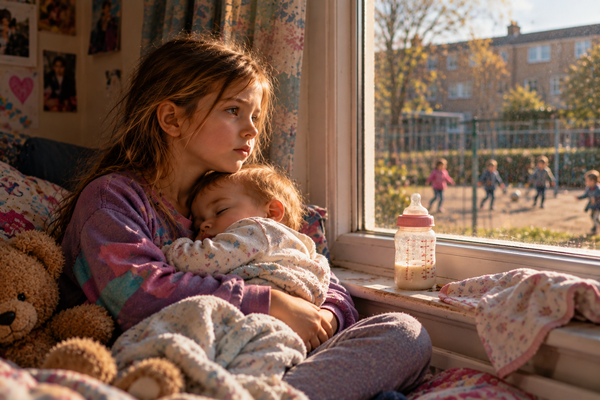
When We Were Finally Allowed to Be Children
When people hear that I spent part of my childhood in women's refuges, they often imagine only sadness and fear. But some of my happiest childhood memories began behind those doors.

I have often told friends and family about the times I lived in women’s refuges as a child. Growing up, we stayed in many different refuges, either because we had no home to go to or because we were fleeing a home that was no longer safe.
The first reaction is usually one of shock or pity.
“How awful for you.”
“You poor thing.”
“That must have been terrible.”
I understood these responses. They were to be expected. The fact that a child had to enter a refuge at all is indeed sad. Yet these reactions have always felt a little strange to me because, when I think back on those parts of my life, sadness is not the only thing I feel.
When I think back to the day we fled my father for good, I remember feeling joyful and free. Of course, I was also excited, nervous, anxious and even a little guilty. The events leading up to our escape had been frightening for a child of eight or nine. In order to leave safely, we had also been forced to leave one of my brothers behind temporarily. Still, there were seven of us children together, and once we realised we were finally free, our excitement seemed to pass from one sibling to another.
The refuge felt secure and welcoming. I remember noticing how clean everything was and how kindly the staff received us. When we were shown to the room where we would all sleep, it never occurred to me that it was only just large enough to hold us. I did not see what was missing or how little space we had.
I saw that we were safe.
I felt incredibly fortunate that somebody had given us somewhere to go. More than anything, I was relieved that Mammy had finally agreed to leave. My older brother had argued passionately that we needed to go before something else happened, and I suggested that we put our concerns in writing and sign the letter as witnesses. Even at eight or nine years old, I understood that something had to change.
For the first time in a long time, we were no longer waiting to see what Daddy would do next. We could begin discovering what it meant to be children again.
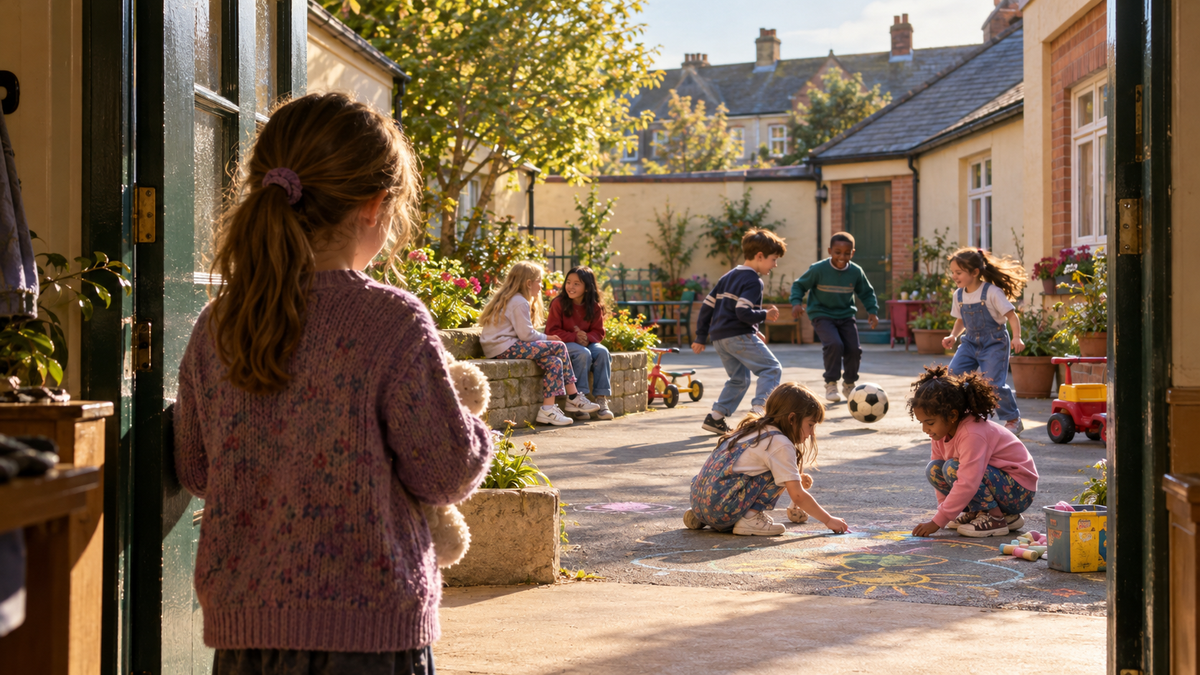
We arrived in the middle of summer, so there was no school. Instead, we spent our days meeting other children and becoming familiar with our new surroundings. There were designated outdoor areas within the refuge where we were allowed to play. We could explore and make friends without constantly wondering whether we would be called back inside or told that we were not allowed out at all.
Our lives gradually developed a rhythm. We ate at regular times and had clean clothes to wear. The adults around us noticed when we needed something, sometimes before Mammy—overwhelmed by circumstances of her own—was able to notice it herself. As summer came to an end, we began attending school every day and became involved in activities beyond the refuge.
None of this may sound remarkable. Clean clothes, regular meals, school, friends and time to play are supposed to be ordinary parts of childhood. But to children whose lives had revolved around hunger, fear and the changing moods of adults, ordinary life felt extraordinary—something that had once seemed unattainable.
It was at the refuge that I truly began to feel like a child again.
When I started at St Louis National School, none of the other children knew where I lived. I was not the girl from the refuge or the girl from the troubled family.
I was simply the new girl.
I made friends almost immediately—and lots of them. At my previous school, I had been ignored, belittled, bullied and sometimes even beaten. Every day was lived with a knot in my stomach. I had learned to make myself small and avoid drawing attention.
But at St Louis, for perhaps the first time in my life, I felt free to be myself: giggly, playful, inquisitive and friendly.
The staff at the refuge recognised how much I loved learning. Whenever I became excited about a school project, they listened to my ideas and helped me find what I needed to bring my little “vision” to life. They did not dismiss my enthusiasm or tell me that I was asking for too much.
They encouraged it.
I joined the Girls’ Brigade and gymnastics and excelled in both. With every friend I made, every project I completed and every new skill I learned, I felt something inside me growing brighter.
My light was beginning to shine more brightly than it ever had before.
My world grew bigger than it had ever been up to that stage in my life. I went on sleepovers and joined friends and their families on trips. I even travelled to London. Each experience offered a glimpse of the ordinary childhood I had longed for—being included in another family’s plans, packing a bag for an adventure and knowing that somebody wanted me there.
At the time, I knew that this was the way life was supposed to be. Looking back, I think I was quietly fulfilling my need for normality through these experiences. For a little while, I could forget about refuges, violence and everything that had made my childhood different.
I was a girl going on a sleepover, travelling with friends or discovering somewhere new.
These moments did not erase what had happened to me, but they showed me that another way of living was possible. In their own quiet way, they helped me begin to heal and realise that childhood could contain friendship, excitement and belonging—not just fear and responsibility.
Within the refuge, the social distinctions that seemed so important in the outside world mattered very little to us as children. Families came from many different places and backgrounds. Some were Irish, including members of the Traveller community. Others had come from African countries, India, Pakistan and the U.K.
I did not yet understand the different circumstances that had brought every family there. The adults did not discuss those things with me and, as children, we rarely asked. I only understood that we were sharing the same space and searching for the same things: safety, shelter and somewhere to belong.
We played together, attended activities together and grew familiar with one another’s families. Our circumstances may have brought us to the refuge, but they did not define who we were within it.
We were a community.
The refuge was not a perfect place, nor was it intended to become our permanent home. Everyone carried a story, whether or not they spoke about it. We had little certainty about what would happen next, but for that period of time, we shared something important: we had reached a place where recovery could begin.
Looking back, I understand that safety is not simply the absence of physical violence.
For a child, safety is predictability.
It is knowing there will be something to eat, that school will happen tomorrow and that wanting to play will not result in punishment. It is being able to fall asleep without listening for signs that an adult’s mood has changed.
The refuge offered us more than a room. It gave us enough safety to learn, make friends and put down responsibilities that should never have belonged to children. It gave us the freedom to be noisy, curious and playful. For a while, we were not responsible for surviving the adults around us.
We were allowed to be children.
That opportunity began before we ever reached the refuge. Members of the Society of St Vincent de Paul had visited our family, bringing food and small comforts into a home where there was often very little. I later came to understand that they had raised concerns about our circumstances on more than one occasion.
Their intervention also helped the telephone number for a women’s refuge reach our family at a time when we desperately needed it.
Sometimes the first step towards safety is something as small as a telephone number placed into the right person’s hand.
For our family, that number opened the door to a different life.
Some of the smallest moments of kindness have remained with me the longest. I wrote about one such memory in Open Your Hand.
The Search for Safety Continues
Today, women and children throughout Ireland are still searching for their own doorway to safety. For some, it begins with a trusted friend, a neighbour or a charity noticing that something is wrong. For others, it begins with a telephone call.
Women’s Aid provides free and confidential information and support to women experiencing domestic abuse. It can help women understand their options and connect with appropriate services in their local area. Its National Freephone Helpline is available 24 hours a day, seven days a week, on 1800 341 900.
In 2025, Women’s Aid responded to 37,790 contacts across its services. During those contacts, women made 62,275 disclosures of abuse against women and children—a 33 per cent increase in disclosures compared with the previous year.
These figures do not necessarily represent 37,790 individual women or 62,275 separate people. One woman may contact the service more than once, and a single conversation may contain several disclosures. But the numbers reveal the continuing need for confidential, specialist domestic-abuse support.
A refuge cannot undo the harm a family has already experienced. It cannot guarantee what will happen once the family leaves. Our time there did not bring our story to a neat and happy conclusion.
When we eventually left the refuge, the stability we had found did not last. Before long, my siblings and I were taken into care.
That is another part of my story.
Knowing what happened next does not diminish what the refuge gave us. If anything, it makes those months of safety, friendship and freedom even more precious. The refuge did not solve every problem surrounding our family, but it gave us a glimpse of what life could be.
When people hear that I lived in a refuge, they often imagine only what I had lost and I remember that too. But I also remember what the refuge gave back to me.
It gave me friends, education, encouragement and freedom.
It allowed my light to shine.
Most importantly, it allowed me to be a child.
Thank you for reading. If this story resonated with you, you are welcome to leave a comment below. And if you would like to follow Stories Within as I continue writing about childhood, care, survival and healing, you can subscribe to receive future articles.
Sources and Support
- Women’s Aid Annual Impact Report 2025
- Women’s Aid support services
- Society of St Vincent de Paul Ireland
Women’s Aid National Freephone Helpline: 1800 341 900, available 24 hours a day, seven days a week.
If somebody is in immediate danger, they should call 999 or 112. Women’s Aid also advises children under eighteen who are worried about their family’s safety to contact Childline on 1800 66 66 66. www.womensaid.ie