Open Your Hand
For once, I had opened my hand expecting pain—and received kindness instead.


The first time I realised our family was different was when we became homeless.
I was about six years old when my mother brought us to a women’s refuge in North Dublin. When I think back to that time, however, homelessness is not what I remember most clearly.
It was being happy.
At the refuge, I felt noticed. There was a community of people living alongside us, all going through difficult circumstances of their own. Some were women seeking refuge from violent partners. Other families had come to Ireland seeking asylum. But we all had one thing in common: we were looking for a place to belong.
People spoke to me and seemed interested in what I had to say.
I had grown up in a family environment where silence and invisibility felt like the only means of self-preservation. To suddenly be seen, heard and encouraged to be myself was a freeing and beautiful experience, even if it initially felt strange.
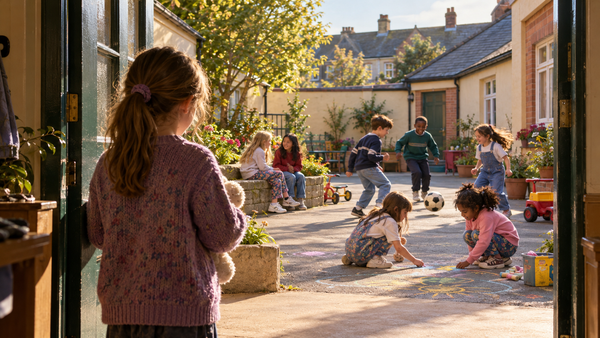
We lived in prefabricated buildings surrounded by concrete paths and patches of long grass. There was a main building where the refuge staff prepared our meals, and a hall where we could dance and play on rainy days.
We were hidden from the outside world, enclosed and guarded by trees as though Mother Nature herself were protecting us.
To somebody else, the prefabs might have looked temporary or bleak. To me, the grounds felt like a place waiting to be explored and the people were friends waiting to be made.
One day, some friends and I decided to go exploring. We wandered between the prefabs and through the long grass until we reached a wire fence.
On the other side, it was as though we had stepped back in time.
Before us stood an enormous white stone building, with tall pillars lining its entrance and cobblestones covering the street. The street was in the midst of battle. Men in green uniforms moved frantically but purposefully, carrying guns as explosions erupted around them and clouds of smoke filled the air.
On one side were cameras and equipment. People dressed in ordinary clothes quietly observed the war unfolding before them, while a man sitting behind a large camera concentrated intently on capturing everything happening around him.
We had no idea what we had stumbled upon. We simply peered through the fence in awe, completely captivated.
Beside the man operating the camera stood another man who noticed us watching. He whispered something to him, and then they both looked in our direction.
My stomach tightened. My head told me to run, but my legs refused to move. My feet seemed frozen to the ground.
I was certain he was coming over to tell us to feck off. That was what adults often told us to do whenever we wandered into something we weren’t supposed to see—and this felt like one of those times.
My heart beat faster as I watched him approach. But instead of shouting, he bent down beside the fence, looked at each of us and smiled.
“Open your hand,” he said.
I looked at my two friends before deciding what to do. One of them was much older than me. I saw her as our mother hen, leading us on our expedition. She happily obliged the stranger, so the rest of us cautiously pushed our little hands through the wire and opened our palms, ready to pull them back if he tried to hit us.
In our house, being told to open your hand meant punishment was coming. It meant a slap from the stick held in my father’s hand—a way of controlling our behaviour. We had learned to brace ourselves before the pain arrived.
But not this time.
The stranger placed what looked like a long, pointed bullet into each of our palms.
“Keep these,” he told us. “They’ll be worth something someday.”
We looked down at the bullets in our hands and then gazed back up at the stranger.
He simply smiled and walked away.
No one chased us from the fence. We remained a little longer, watching the battle unfold, until we eventually ran back through the long grass towards our prefabs, shouting with excitement.
For years, I never knew what we had witnessed that day.
Then, when I was seventeen, I watched Michael Collins for the first time with my boyfriend—now my husband—at his home in Shankill, Dublin.
As the battle at the GPO appeared on the screen, I was suddenly six years old again, standing in the long grass and peering through a wire fence with my hand outstretched.
“I was there!” I shouted.
My boyfriend looked at me, completely bewildered.
Only then did I understand what we had stumbled upon that day.
I don’t know whether those bullets ever became worth anything. Being a child, I simply lost mine.
But the memory did.
For once, I had opened my hand expecting pain—and received kindness instead.